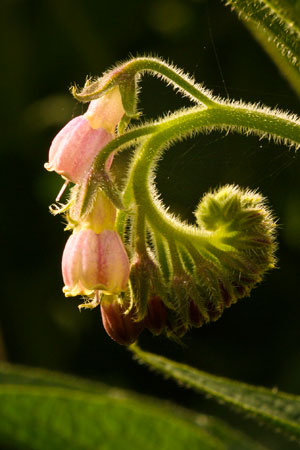
| Scientific: | Symphytum officinale |
|---|---|
| Other: | Comfrey |
| Family: | Boraginaceae |
Comfrey is a vulnerary herb used for both dermatological and musculoskeletal complaints. Its common name “knit-bone” alludes to its historical use for speeding the healing rate of bone fractures, but its use extends to soft tissue trauma as well, such as muscle pain and trauma. It contains important anti-inflammatory compounds, and research supports that topical application may benefit those suffering from arthritis and back pain. In addition, comfrey is a common ingredient in cosmetics and skin creams, used to decrease irritation and inflammation of the skin resulting from eczema and dermatitis. Research suggest it may help heal leg ulcers.
Caution: Historically comfrey was taken orally for gastrointestinal complaints but now it is exclusively used topically because Health Canada and other government organizations have banned the internal use of comfrey. Comfrey contains hepatotoxic compounds (pyrrolizidine alkaloids) that cause liver damage when consumed orally.
Dermatologic (topical application)
• soft tissue injury
- burns
- bruises
- sprains
- contusions
- decubitus ulcers
- bursitis
- diabetic ulcers
- pressure ulcers
• thrombophlebitis
• eczema
Musculoskeletal (topical application)
• hard tissue injury
- fractures
- tendonitis
- osteomyelitis
• osteoarthritis
Gastrointestinal†
• ulceration
• diarrhea
• gingivitis
• apthous ulcers
• gastric ulcer
• duodenal ulcer
• dysentery
• colitis
*Note: Although historically used internally, Health Canada prohits the internal use of comfrey.
• Vulnerary
• Antiinflammatory
• Demulcent
• Expectorant
• Astringent (Root)
• Gastroprotective
• Mucilage
• Phenolic Acids
• Tannins
• Purine Alkaloids Derivatives (Allantoin)
• Steroidal Saponins
• Pyrrolizidine Alkaloids †
• Poultice (steamed leaf): applied topically to wounds
• Tincture (1:5 in 25% EtOH): 2-4 ml tid
• Decoction (dried herb): 2-4 g tid
Contraindications: Liver disease.
† Pyrrolizidine alkaloids (PAs): Excessive oral consumption of pyrrolizidine alkaloids (PAs) can cause hepatotoxic. Internal use of comfrey is banned in certain countries.
Barnes J, Anderson LA, Phillipson JD. Herbal Medicines, 3rd ed. London: Pharmaceutical Press, 2007.
Bone K. Principles and Practice of Phytotherapy. Edinburgh: Churchill Livingstone, 2000.
Bone K. A Clinical Guide to Blending Liquid Herbs: Herbal Formulations for the Individual Patient. St Louis, MO: Churchill Livingstone, 2003.
Brinker F. The Toxicology of Botanical Medicines, 3rd ed. Sandy, Oregon: Eclectic Medical Publications, 2000.
Felter HW, Lloyd JU. King's American Dispensatory. 1898. http://www.ibiblio.org/herbmed/eclectic/kings/main.html. Accessed: August 19, 2006.
Hoffman D. Medical Herbalism. Rochester, Vermont: Healing Arts Press, 2003.
Weiss RF. Herbal Medicine. Beaconsfield, England: Beaconsfield Publishers Ltd, 1988.
Williamson EM, ed. Major Herbs of Ayurveda. Edinburgh: Churchill Livingstone, 2002
Disclaimer: This content is subject to change. The information is intended to inform and educate; it does not replace the medical evaluation, advice, diagnosis or treatment by a healthcare professional. www.nhpassist.com © 2014 NDAssist Inc. and/or its affiliates. All rights reserved.
|
ComfreySummaryComfrey is a vulnerary herb used for both dermatological and musculoskeletal complaints. Its common name “knit-bone” alludes to its historical use for speeding the healing rate of bone fractures, but its use extends to soft tissue trauma as well, such as muscle pain and trauma. It contains important anti-inflammatory compounds, and research supports that topical application may benefit those suffering from arthritis and back pain. In addition, comfrey is a common ingredient in cosmetics and skin creams, used to decrease irritation and inflammation of the skin resulting from eczema and dermatitis. Research suggest it may help heal leg ulcers. IndicationsSign in requiredActionsSign in requiredConstituentsSign in requiredPosologySign in requiredSafetySign in requiredReferencesSign in required |
|---|